The Financial Industry Regulatory Authority (FINRA)’s 2026 Annual Regulatory Oversight Report aims to strengthen the standard for how businesses interpret, operationalise, and demonstrate compliance across seven key risk areas.
It brings attention to generative AI, sharpens the focus on areas where businesses still fail, and upholds long-standing standards for governance, control design, and supervision.
The one thing that stands out from the report is that the firms are not being evaluated on their knowledge of rules but on their ability to apply the rules in a much more complicated risk environment.
The report intends to be integrated directly into organisations’ compliance preparation for 2026. It uses FINRA’s examination, surveillance, and enforcement action to identify where businesses continue to suffer, especially in areas that have been regulatory priorities for years.
FINRA’s Executive Vice President and Chief Regulatory Operations Officer Greg Ruppert states that the report “captures important findings and translates them into practical guidance our member firms can act on immediately.”
As regulatory expectations grow in volume and complexity, firms can no longer rely on manual monitoring, fragmented regulatory updates, or static rule interpretations.
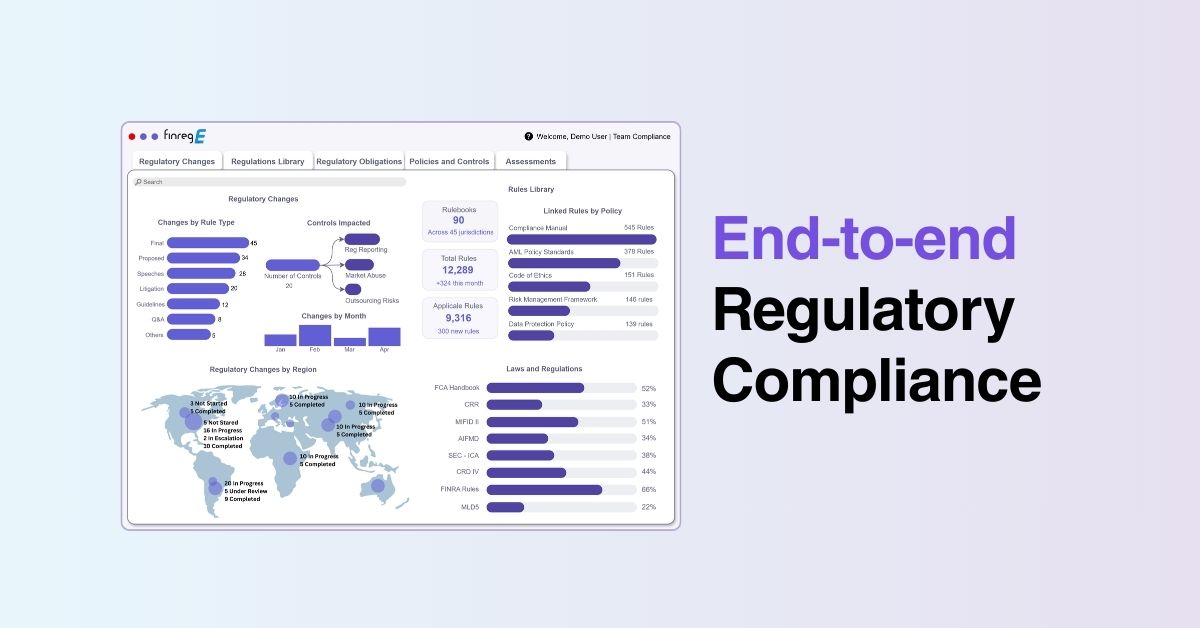
FinregE helps compliance teams to convert FINRA’s findings into actionable controls, mapped obligations, and ongoing regulatory intelligence, ensuring firms go further than just understanding what FINRA expects by proving that they’re meeting those expectations.
From static compliance to execution under pressure
There is a common theme that is present in the 2026 report. Risks are no longer separate, linear, or slow-moving.
- Generative increases efficiency and fraud.
- Cyber threats now directly cause AML (Anti Money Laundering) and customer protection issues.
- Market manipulation has spread from specialised areas of the market into listed securities.
- Operational failures at third-party vendors might affect dozens of businesses at once.
Against this backdrop, FINRA’s expectations are becoming less forgiving.
Having a policy is not sufficient. Having control is not sufficient. Firms are increasingly asked to demonstrate how risks are identified early, controls are adaptable, and supervisory judgement is implemented in practice.
The seven key topics mentioned in the report reflect this trend.
Financial crimes prevention: convergence, not silos
FINRA’s conclusions about preventing financial crimes prevention shows how obsolete and isolated compliance systems have become. Cybersecurity incidents, external fraud, and AML failures are no longer separate issues. They are different manifestations of the same risk environment.
The report highlights persistent deficiencies in handling identity-theft-related account activity, reporting red flags discovered outside of AML teams, and tailoring AML programs to business models. It also emphasises how deepfake impersonation and automated social engineering are two ways that generative AI is increasingly enabling fraud.
The implication is obvious for businesses. Financial crime controls need to be risk-based, integrated, and responsive to threats rather than just another field in the organisational structure of compliance functions.
GenAI: governance is now the test
GenAI got a dedicated section in the 2026 report. FINRA recognises that businesses are already utilising GenAI, primarily for internal efficiency, information extraction, and summarisation. The lack of governance is what worries the regulator, not experimentation.
FINRA makes it clear that when AI is involved, all current regulations related to supervision, communications, recordkeeping, and fair dealing fully apply. AI agents are highlighted because they present risks related to autonomy, opacity, and auditability that, if unchecked, could quickly result in investor harm.
The message is not that businesses should stay away from AI. It’s that they need to understand it sufficiently to oversee, record, and clarify it.
Firm operations: accountability doesn’t stop at the vendor
FINRA continues to prioritise operational resilience and third-party risk. A single cyber incident or outage can have a systemic effect because businesses are depending more and more on outside vendors for vital systems and data.
The report identifies recurring shortcomings in incident response planning, due diligence, and vendor inventories. Additionally, it highlights FINRA’s CORE (Cyber & Operational Resilience) initiative, which aims to provide member firms with more proactive cyber and technological risk intelligence.
The lesson is straightforward but challenging for leaders in operations and compliance. Businesses need to be able to show continuous supervision, not just the initial choice of vendors.
Crypto activities: innovation without exemption
One noteworthy aspect of FINRA’s 2026 report is how it handles crypto-related activity. It doesn’t establish a distinct regulatory structure. Rather, it reaffirms that conventional norms still hold true.
FINRA draws attention to persistent problems in crypto communications, especially when influencer marketing and social media promotions are misleading or unfair. It also highlights shortcomings in AML regulations and oversight of crypto-related non-business operations.
To put it another way, crypto stays well inside the bounds of regulation. Businesses that participate in these activities are expected to use the same level of discipline as they would with any other good or service.
Communications and sales: digital is now the default risk channel
One of FINRA’s most reliable sources of information is still communications supervision, and the 2026 report focusses more intently on how businesses function in a digital-first setting.
FINRA still observes shortcomings in maintaining digital communications, monitoring social media influencers, and recording Regulation Best Interest justifications. Push notifications, nudges, and mobile apps for complex products have also come under fire.
This indicates that communications risk is now more behavioural than editorial. Businesses need to monitor not only what content says but also how it is produced, shared, and consumed.
Market integrity: understanding your own market footprint
The Consolidated Audit Trail accuracy, best execution, fixed income fair pricing, market access controls, and extended hours trading are just a few of the many topics covered in the market integrity section.
FINRA’s findings reveal a common flaw in all these areas. Businesses frequently lack a comprehensive grasp of how orders are processed, pricing decisions are made, and exceptions are found and handled.
Regulators continue to focus on under-tuned surveillance systems, poorly documented error correction procedures, and reviews that are not really “regular and rigorous.”
FINRA expects understanding and control rather than perfection.
Financial management: resilience over minimums
Lastly, FINRA’s emphasis on financial management serves as further evidence that adherence to regulations pertaining to net capital, liquidity, and customer protection goes beyond simple reporting.
Inaccurate books and records, errors in liquidity reporting, long-standing problems with incorrectly calculated net capital, and shortcomings in client reserve and segregation procedures are also identified in the report. It also reminds companies of impending regulatory deadlines that could have a big influence on capital and liquidity strategy.
Resilience is the primary focus. FINRA evaluates a company’s ability to endure stress rather than merely meeting minimum requirements on paper.
What FINRA is really asking firms to do in 2026
When considered collectively, the 2026 Oversight Report focusses more on increased expectations than on new dangers.
FINRA is requesting that businesses:
- Handle regulatory intelligence as an ongoing input rather than an annual review
- Align controls with how risks emerge and interact
- Demonstrate supervision, judgement, and accountability
- Anticipate issues before they appear as exam findings
As Ornella Bergeron, FINRA’s acting head of member supervision, noted, “the goal is to give firms the intelligence they need to build stronger compliance programs and more resilient operations, not simply to catalogue past failures”.
Where FinregE fits into this shift
It takes more than just following the rules to meet FINRA’s requirements in the seven interrelated risk areas. It requires a clear understanding of how operational reality impacts regulatory duties.
FinregE helps firms:
- Stay updated on FINRA, SEC, and global regulatory changes
- Interpret regulatory change in the context of real business activities
- Map obligations to internal policies, controls, and procedures
- Maintain a clear audit trail showing how regulations are implemented and supervised


By turning regulatory intelligence into operational clarity, firms will be able to demonstrate control effectiveness, reduce exam risk, and stay ahead of supervisory focus areas.
Book a demo today.